




Around the Table: How Shared Meals Strengthen Our Camp Community
Around the Table: How Shared Meals Strengthen Our Camp Community
Our partner camp, Farm Camp, recently shared a blog post titled How Shared Meals Strengthen Our Camp Community, celebrating how something as simple as gathering around food can shape meaningful connections. At Farm Camp, those shared meals where campers slow down, enjoy warm conversations, and connect over good food become experiences that stay with them long after summer ends.
While our campers at Mountain Camp Woodside are not with us for breakfast or dinner like the overnight campers at Farm Camp, we deeply value the time they share during lunch and snack. Those moments, eating side by side, swapping stories, laughing with counselors, and taking a breath in the middle of an exciting day give kids a chance to refuel, both physically and emotionally.
That’s what we love across our family of camps: Mountain Camp Woodside, Farm Camp, Mountain Camp – Tahoe, and Mountain Camp Marin. It’s in those small shared experiences, whether around a campfire or lunch table, that friendships strengthen, kids feel seen and supported, and memories take root.
Why Shared Meals Matter
Recent research confirms what so many of us have felt that sharing meals is a powerful way to build connection, belonging, and well-being. According to the 2025 World Happiness Report (WHR), people who dine with others frequently report significantly higher life satisfaction, more positive emotions, and less negative affect across ages, cultures, and countries (6).
Eating together doesn’t just feed our bodies, it nurtures our social bonds. Numerous studies describe communal dining (sometimes called commensality) as a key ritual for forging and reinforcing trust, friendship, and sense of belonging (3).
Moreover, communal meals offer more than emotional benefits. For children and teens, regularly eating family-style meals, where everyone sits and eats together, is linked to better mental health, healthier eating habits, reduced risky behaviors, and even improved academic performance (1).
How This Aligns with Our Farm Camp Philosophy
When we look at our history and philosophy, we’re reminded that our camp was founded not just as a place to play and learn, but as a place to belong. On our “About” page, we talk about the importance of community, connection, and living in rhythm with the land, the animals and each other.
Our family-style breakfasts and dinners reflect those values intentionally. At each table, campers and counselors share food, stories, questions, and experiences. These moments often become the seeds of friendships, trust, and the kind of community that lasts long after camp is over. As our campers often say, “we start the week as a table full of strangers and end the week as a little family”.
In a world where more and more people dine alone, surrounded by screens or time constraints, our camp offers real, unhurried time together. Research suggests this matters: shared meals can improve emotional well-being, reduce loneliness, and strengthen social support networks (5).
What Happens at Our Tables
Here’s what typically happens when we sit down together at camp:
- Conversation & Listening. From tales about the day, hopes for the summer and beyond, to stories about home, mealtime becomes a space for sharing and reflection.
- Learning & Caring. Campers learn to serve themselves, pass dishes, and respect each other’s needs. Manners are modeled by counselors, and we always ask the table who would like more before we serve ourselves. Campers leave their time at camp more conscious and aware of the needs of others, and hopefully with bellies full of delicious food too!
- Laughter & Play. Jokes, spontaneous songs, silly games — these lighten the mood and help break down barriers. Do you know the games Vase-Face, Concentration or Chicken Taco? If not, ask your camper, it’s a great way to pass the time as you wait to be dismissed to do your dishes!
- Belonging & Trust. Over time, campers begin to feel seen and valued. Due in part to small table sizes, and a mix of ages and genders at the table, campers have the opportunity to be seen and heard by people with whom they otherwise may not have interacted. They make connections outside of their unit groups and have another touch point in the community.
These moments embody the spirit of our camp: cooperation, respect, shared growth, and belonging within the community.
Why It Matters
The benefits ripple beyond camp. Campers develop the habits of sharing meals, listening, and connecting, which helps young people build social confidence, empathy, and a sense of belonging. These are qualities that matter deeply in adulthood. Research shows that regular communal eating supports better mental health, more stable relationships, and overall well-being (2&4).For our camp community, shared meals anchor us. They remind us that we’re more than a group of individuals working or playing together. We are growing, caring, learning — together.
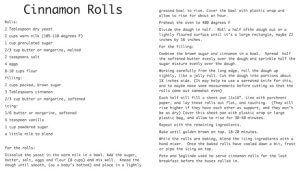
This month we wanted to share a beloved camp recipe with you and your family; Cinnamon Rolls! We hope that you’ll be able to bake these together and share them with those you love this holiday season.
- Bernardi, Elisabetta, and Francesco Visioli. “Fostering Wellbeing and Healthy Lifestyles through Conviviality and Commensality: Underappreciated Benefits of the Mediterranean Diet.” Nutrition Research, vol. 126, 1 June 2024, pp. 46–57, https://doi.org/10.1016/j.nutres.2024.03.007.
- Dunbar, R. I. M. “Breaking Bread: The Functions of Social Eating.” Adaptive Human Behavior and Physiology, vol. 3, no. 3, 2017, pp. 198–211, link.springer.com/article/10.1007/s40750-017-0061-4, https://doi.org/10.1007/s40750-017-0061-4.
- Jönsson, Håkan, et al. “What Is Commensality? A Critical Discussion of an Expanding Research Field.” International Journal of Environmental Research and Public Health, vol. 18, no. 12, 9 June 2021, p. 6235, www.mdpi.com/1660-4601/18/12/6235, https://doi.org/10.3390/ijerph18126235.
- “Shared Meals: A Predictor of Subjective Well-Being.” Center for Health & Well-Being, 2025, www.ie.edu/center-for-health-and-well-being/blog/shared-meals-a-predictor-of-subjective-well-being/.
- UCL. “Sharing Mealtimes with Others Linked to Better Wellbeing.” UCL News, 20 Mar. 2025, www.ucl.ac.uk/news/2025/mar/sharing-mealtimes-others-linked-better-wellbeing.
- “World Happiness Report 2025: People Are Much Kinder than We Expect, Research Shows | Saïd Business School.” Ox.ac.uk, 20 Mar. 2025, www.sbs.ox.ac.uk/news/world-happiness-report-2025-people-are-much-kinder-we-expect-research-shows.